Wednesday, 19 October 2016

Margin Call

Resultado de imagen de margin call 
  • Title: Margin Call
  • Duration: 109 minutes
  • Country: United States
  • Director: Jeffrey C. Chandor
  • Script: Jeffrey C. Chandor
  • Year: 2011
  • Synopsis: A respected financial company is downsizing and one of the victims is the risk management division head, who was working on a major analysis just when he was let go. His protégé completes the study late into the night and then frantically calls his colleagues in about the company's financial disaster he has discovered. What follows is a long night of panicked double checking and double dealing as the senior management prepare to do whatever it takes to mitigate the debacle to come even as the handful of conscientious comrades find themselves dragged along into the unethical abyss. 


'Banking and finance' in the film

Margin Call is presented as the film that not only made it easy to understand the financial crisis but, above all, denounce those responsible for the economic crash. The film revelation on Wall Street, tells the fall of Lehman Brothers and portrays the behavior of financial power and excesses that led to the capitalist system to the worst crisis since the Crash of 1927.


The film traps, in particular, with the story of contradictions that live two heads of finance night of bankruptcy of a major investment bank. On the one hand, the capitalist appears who cares only about the money, even if their decisions by a catastrophic depression is loose. On the other hand, it portrays the head of sales who, after running all adjustment plans in the company, enters a breakdown of values ​​knowing that would be initiating a global collapse. Output, argues that all that could be avoided with better control those who make the decisions. Given these two positions, the film is inclined to the second and presents the former as the culprit of all evil. A bad start that will lead to the economic crisis.


Personal commentary

In the wake of the crisis that rocked world financial markets in 2008, many people asked that very question engineers disaster. How a man to reality faces failure? a failure that can not only cost him the job but threatens the livelihoods of millions of people. Margin Call, the fascinating and torn thriller J.C. Chandor takes us into a territory that has not brought us any other film: the heart of one of those financial giants of Wall Street too big to fail.

Margin Call reveals a truth that is as moving as disturbing: that men and women who were at the origin of the financial crisis were just ordinary human beings who, by their knowledge, intelligence and his amazing rewards, end up being victims of their negligent, short-sighted and irresponsible priorities. Wall Street may not have a soul, but individuals working in their sanctuaries of power if they do. Margin Call tells the story of these souls and the longest and darkest night of their lives, where they are on the brink of a precipice that they have contrived.
One can say without exaggeration that fall into the financial crisis has affected all inhabitants of the planet, but Margin Call roots come from a very personal situation screenwriter and first-time director J.C. Chandor.

One of the key scenes of the film, without any doubt, is the following:


Another of the most important scenes of the film takes place in the investment bank, where spent the whole plot, in it we can observe the hours before the start of the economic crisis of 2008.


Resultado de imagen de margin call wall street


Money Monster

Money Monster

  • Title: Money Monster
  • Duration: 100 minutes
  • Country: United States
  • Director: Jodie Foster
  • Script: Alan DiFiore, Jim Kouf, Jamie Linden
  • Year: 2016
  • Synopsis: Lee Gates is a striking TV celebrity whose popular financial program has become the wizard of Wall Street money. But after he recommended a high-tech stocks falling mysteriously, an angry investor takes hostage Gates, his team and his efficient producer Patty Fenn while the program is broadcast live. Running in real time, Gates and Fenn must find a way to stay alive while discovering the truth behind a network of large financial lies.

'Banking and finance' in the film

Money Monster: `The economy slipped through our hands'

The story of a young man can not think of anything better to follow the advice of a television program about finances

The economy was only an invention of man to make us easier coexistence in the society. The era of barter was only tauhgt man that the chances of getting rich did not stay in `taje this I give you in return for the other´.

The economy is an abstraction, a monster like Frankenstein. The man, honestly, wanted to do good but in the end the creature got out of hand. Why? The avariace.

Money Monster tells the story of a poor young man who can not think of anything better to follow the advice of a television program about finances.
Lee Gates begins to recommend investments in high-risk technology stocks that soon crumble in the stock market, which hurt many speculators.
Among those affected is Kyle Budwell, who lost all his monet and his family for taking the recommendations of Gates.

In the next scene we can see some economic and financial explanations that gave the famous television presenter, Lee Gates, while filming one of his programs.
In addition, we can appreciate the moment in which the young protagonist, Kyle Budwell, decides to kidnap the presenter in live, with the rest of the television crew workers.


Personal commentary

In the background, Kyle may knows that Lee Gates is not at fault but he has the need to blame someone for their economic failure.

While wealth is generated nobody complains about the economy but when it fails all pounce on it as if it were absolute evil.


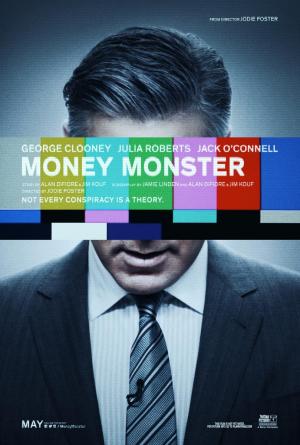
Resultado de imagen de money monster


There is no greater mystery than the origin and whereabouts of the money. Intrigue or exceeding the enigma of who pulls the strings orchestra Wall Street and the global economy. Is there anything more disturbing capital sin of greed?, from which all others are possible on your behalf. It is logical, therefore, that the finances are an inexhaustible source of inspiration for the film, and that many of those frames end up narrating in key thriller with titles as explicit as Money Monster.
A thriller with two of the biggest stars of Hollywood in its cast, George Clooney and Julia Roberts, and plot a closely related with the economic recession that we are living in recent years.
Money monster makes reference to the media power of television and the ups and downs of the economic system.

The director, Jodie Foster, has managed to combine the thriller frenetic with a portrait of a world in which appearances devour reality, people let manipulate and emerge the hidden interests of capitalism that have made the beast that devours everything.

The Wolf of Wall Street


  • Title: The Wolf of Wall Street
  • Duration: 129 min
  • Country: United States
  • Director: Martin Scorsese
  • Script: Terence Winter (Book: Jordan Belfort)
  • Year: 2013
  • Synopsis: Young middle-class Jordan Belfort (Leonardo DiCaprio), a hard-partying, drug addicted New York stockbroker and owner of the company Stratton Oakmont, refuses to cooperate in a massive securities fraud case that involves widespread corruption on Wall Street and in the corporate banking world, including mob infiltration. Based on the autobiography by Jordan Belfort.


'Banking and Finance' in the film 

In the movie “The wolf of wall street” it is related to our subject because that during the film is about buying and selling stocks at high risk and that the protagonist sold as safe investments, because of the high commissions they get for it.
We want to highlight the following scenes

Black Monday:
        In this scene is reflected one of the worst fall of the bag of history, happened on October 19, 1987 and is known as Black Monday, our protagonist Jordan R. Belfor, lost his job since that day his Financial institution LF Rothschild, fell into bankruptcy

Selling penny stocks as a safe investment:
        In this scene, Jordan R. Belfort, is looking for work as a stockbroker, gets a job in a place that has nothing to do with Wall Street, discover the penny stocks and huge margins that can be carried with them , Then begins to work and the rest of employees are astonished by their ability to sell shares, this will be a turning point in the movie from here begins to plot your scam

The Fraud:
        In this scene is reflected the creation of the company Stratton Oakmont where Jordan R. Belfort started his scam, giving his clients investments with high risk as safe, and manipulating the securities market that was accused later.

Tax Haven:

        In this scene is reflected the money laundering by Jordan R. Belfort where with the illicit money of his fraud, goes to the tax amnesty that offers a Swiss bank.

Personal commentary


If I had to choose a single word to describe this film, I would say inmoral. Some people may think the movie is an apology to the excess and madness. Although it is a sucession of excesses: sex, drugs and lots of money, I think the movie is an essential film for the ones who love cinema. At the end of the film everyone will want to be a broker like Jordan Belford. 

The Big Short


  • Title: The Big Short
  • Duration: 123 min
  • Country: Estados Unidos
  • Director: Adam Mckay
  • Script: Adam Mckay, Charles Randolph(Book: Michael Lewis)
  • Year: 2015
  • Synopsis: Three separate but parallel stories of the U.S mortgage housing crisis of 2005 are told. Michael Burry, an eccentric ex-physician turned one-eyed Scion Capital hedge fund manager, has traded traditional office attire for shorts, bare feet and a Supercuts haircut. He believes that the US housing market is built on a bubble that will burst within the next few years. Autonomy within the company allows Burry to do largely as he pleases, so Burry proceeds to bet against the housing market with the banks, who are more than happy to accept his proposal for something that has never happened in American history. The banks believe that Burry is a crackpot and therefore are confident in that they will win the deal. Jared Vennett with Deutschebank gets wind of what Burry is doing and, as an investor believes he too can cash in on Burry's beliefs.


'Banking and Finance' in the film


        "The Big Short" is a movie with the subject of "Banking Management" because through with housing bubble is created financial instruments CDO with a very high percentage subprime mortgages (which are mortgages with high risks of default to paid) and the abuse of these financial instruments by banks they made them fall into bankruptcy, by increasing unpaid mortgages.
We want to highlight the following scenes

Start of mortgage rates:
        In this scene appears Lewis Ranieri, who will be the father of mortgage titles, explaining to a major pension fund company, a new financial instruments through the union of thousands of mortgages

Subprime:
        In this scene appears "Michael Burry" who discovers as there are numerous bonds that are with a high percentage of subprime mortgages and deduces that from 2007 the bonds were worthless, we are also explained that this was because the banks needed more Mortgages and as they all had the requirements,the banks assumed mortgages with high risks, faced with this situation "Michael Burry" decides to sell short mortgage securities, in other words to bet against the mortgage market

Credit rate agency:
        In this scene, Mark Baum (although in real life refers to Steven Eisman) goes to the rating agency because he does not understand how CDO products do not degrade in their rating when the delay in payment on mortgages  is on the rise, and discovers how agencies do not Have Rigor and simply qualify the CDOs as banks want

CDO:
        In this scene Greg Lippmann a brilliant Deutsche Bank intermediary on Wall Street explains how the CDOs have been formed and they will become junk bonds, and offers you to use this information for a great business opportunity.

Synthetic CDO:
        In this scene we are explained in detail that it is a synthetic CDO, so Steven Esiman (Mark Baum in this film) realizes the serious financial situation and sees that in a short time the crisis will explode


Personal commentary

       This is a very interesting film from diferent points of view: on how to engage the viewer and, at the same time, on how to deal with complex financial issues. The film succeeds in blending realistic approach with a a great sense of entertainment. 'The big short' makes us perfectly understand the difficulties of the origin of the crisis. Definitely, it is a remarkable film, with clear ideas, which gets what it looks for.