Friday, 11 November 2016

Rogue Trader


  • Title: Rogue trader
  • Duration: 98 min.
  • Country: United Kingdom
  • Director: James Dearden
  • Script: James Dearden
  • Year: 1999
  • Trailer: https://www.youtube.com/watch?v=vgqSVVLFmds
  • Synopsis: Ambitious, wide-eyed boy Nick Leeson is determined to rise in the world and be more than a simple bank clerk. When his employers, Barings Bank, offer him the opportunity to go to Jakarta to sort out a problem that nobody else wants, he seizes the opportunity with both hands. In Jakarta he meets and marries Lisa and together they go to Singapore when the bank offers him the job of setting up their future options trading operation. To save money the bank allows Nick to operate both the floor trading and the back office facilities and force him to employ cheap, unskilled staff. His first year of trading is a big success and he makes large profits for the bank even though he has illegally broken trading rules and secretly covered up losses. Given more freedom, even more money and continuing unchecked, Nick starts to make losses and again attempts to trade out of them but this time he comes unstuck as his illegal trading generates even bigger losses. After the death of his unborn child Nick completely loses control and gambles without restraint with other people's money leading inevitably to a complete financial meltdown and the bankruptcy of the bank.


'Banking and Finance' in the film

The film starts with Nick's voice in off commenting that he works for a bank. Then he introduces us a little in the Indonesian economy and explains he is going to sell bonds there. Later on, Nick explains his financial work to his new mates and starts working in the Nikkei. A bank's CEO speech about the company policies is also rolling. All of this occurs in the first 20 minutes, and after that, the film develops its roll with the Nick’s methods. With losses and profits and what carries on.


Personal commentary
It shows perfectly the irrationality that often investors can incur due to the inherent human clumsiness (of the protagonist as well as his bosses and admirers).  It perfectly reflects the inefficiencies that may exist in a bank.

Capitalism: a love story


  • Title: Capitalism: a love story
  • Duration: 127 min.
  • Country: EEUU
  • Director: Michael Moore
  • Year: 2009
  • Trailer: https://www.youtube.com/watch?v=CkTkYQkG13w
  • Synopsis: Capitalism: a love story is a documental that try to teach how the governments and companies drive the people´s live. The American dream fades dangerously while families lose their jobs, their homes and the savings of their entire lives. To discover the real culprits of this planetary crisis, the director goes deep into the social strata of the United States, from the humblest homes to the government corridors in Washington. A documentary wondering what the price paid by the most powerful country in the world for its love of capitalism. Capitalism, a love story" is an analysis of the global crisis from the bowels of the great American corporations, but also a portrait of the families that have lost everything. All this in the shadow of the 14,000 jobs that are lost every day.

'Banking and Finance' in the film
The documentary shows us how the banking system works in our lives so its goes hand on hand with our subject about banking management.

Personal commentary
Our documentary shows us the dark side of the bank,on both sides of the Atlantic, have since gone on paying ­themselves massive wedges, content in the knowledge that if anything else goes wrong, the rest of us will once more ­obediently stump up. If merchant bankers fall ­behind with their debts, they get to stand under a gorgeous waterfall of ­public money. If ordinary folk get ­behind with their mortgage debts – such a delicious ­income stream for bankers – well, they get to live in their car.

Monday, 7 November 2016

The Flaw


  • Title: The Flaw
  • Duration: 82 min.
  • Country: United States
  • Director: David Sington
  • Script: David Sington
  • Year: 2011
  • Trailer: https://www.youtube.com/watch?v=C7IQe7CBPCc
  • Synopsis: The film shows how excessive income inequality in society leads to economic instability. At a time when economic theory and public policy is being re-examined this film reminds us that without addressing the root causes of the crisis the system may collapse again and next time it may not be possible for governments to rescue it. People all over the world are still struggling with the aftermath of the greatest financial crisis since the Wall Street Crash of 1929. We all know what the effects have been but what exactly were the causes? The Flaw ranges widely across the history of American capitalism in the twentieth century, its rigor laced with sardonic humor and peopled with a cast of characters that spans Nobel-prize winning economists and distressed home owners to the New York Times financial correspondent on the brink of foreclosure and the Wall Street banker who feels the pain encoded in his spreadsheets. The film argues that the roots of the crisis lie in the changing relationship between the rich and the rest in American society.

Banking and Finance' in the film
Splices the thoughts of economists such as Robert Shiller and Joseph Stiglitz with the testimony of participants in the housing market and some entertaining cartoons and archive clips. Mr Sington's case is that the boom and bust was closely tied up with the growing inequality of the US population that emerged after 1980. As wealth accumulated in the richest 1% of the population, the living standards of the bottom 50% stagnated. To maintain his or her standard of living the average.

Personal commentary

The Flaw admirably goes back to chart the course of financial policy from the 1920's to today, making startling connections in economic variables across the period and putting all this mess into the context of history. The Flaw has the misfortune of telling the same story as Inside Job and then the only movie yet to have made clear the cause and effect of the financial collapse of 2008.

Inside Job


  • Title: Inside Job
  • Duration: 105 min.
  • Country: United States
  • Director: Charles Ferguson
  • Script: Charles Ferguson, Chad Beck, Adam Bolt
  • Year: 2010
  • Trailer: https://www.youtube.com/watch?v=FzrBurlJUNk
  • Synopsis: From Academy Award® nominated filmmaker, Charles Ferguson ("No End In Sight), comes INSIDE JOB, the first film to expose the shocking truth behind the economic crisis of 2008. The global financial meltdown, at a cost of over $20 trillion, resulted in millions of people losing their homes and jobs. Through extensive research and interviews with major financial insiders, politicians and journalists, INSIDE JOB traces the rise of a rogue industry and unveils the corrosive relationships which have corrupted politics, regulation and academia. Narrated by Academy Award® winner Matt Damon, Inside Job was made on location in the United States, Iceland, England, France, Singapore and China.


'Banking and Finance' in the film
'The global economic crisis of 2008 cost tens of millions of people their savings, their jobs, and their homes'
This film is structured in five parts that track very well the story: 
1. How did we get here? 
2. The bubble. 
3. The crisis. 
4. Responsibilities. 
5. Where are we now?

Scene 1: 19:20-21:00
The deregulation allowed to launder money and could falsify the accounts of a much easier way, did not have to overcome many obstacles.


'We will continue to grow'
'The recession had actually started four months before Paulson made this statement'

Scene 2: 59:00-1:00:00
They knew the situation but tried to hide it until the end. Perhaps they could have diminished the consequences of the crisis or the domino effect.

Personal commentary
This documentary has helped us to understand quite clearly some aspects of the crisis that we did not understand well. We have seen how it was creating a deregulation in the financial sector that helped bankers to increase their income through a chain scam. Also, we can see that in this documentary that questions are addressed to those that led to the crisis, which came to keep their jobs. Not like millions of people who lost their homes.

Sunday, 6 November 2016

The last days of Lehman Brothers


  • Title: The last days of Lehman Brothers
  • Duration: 60 min
  • Country:  United Kingdon
  • Director: Michael Samuels
  • Script: Craig Warner
  • Year: 2009
  • Trailer: https://vimeo.com/19481124
  • Synopsis: The Last Days of Lehman Brothers summarizes the events that occurred over the weekend preceding Monday, 15 September 2008, when Lehman declared bankruptcy. Some of the story is narrated by the fictional character "Zach", a Lehman employee often taking orders directly from Dick Fuld. Zach often breaks the Fourth wall, talking directly to the viewer.
'Banking and Finance' in the film
In this film, based on the true story of the company Lehman Brothers, we can see how they treat topics we study, as toxic assets (scene of the trailer) and again the issue of professional ethics in the world of finance.


Personal comentary
The film shows how the beginning of the crisis the company was experienced from the point of view of an employee. What is striking is the ease with which the leaders of these companies to try that savers are those who have to bear the economic burden of their bad financial practices.

The Bank


  • Title: The Bank
  • Duration:  106 minutes
  • Country:  Australia
  • Director: Robert Connolly
  • Script:  Robert Connolly
  • Year: 2001
  • Trailer: https://www.youtube.com/watch?v=vPXK-FfnXxU
  • Synopsis: Jim Doyle (David Wenham) is a maverick mathematician who has devised a formula to predict the fluctuations of the stock market. When he joins O'Reilly's fold, he must first prove his loyalty to the "greed is good" ethos.

'Banking and Finance' in the film
As a film about banks, the scenes that take place in branches dealing with topics studied in class, for example economic transactions,  professional ethics of banks and employees, etc.

Personal comentary
The film mainly deals with the greed of the banks, their eagerness to get richer regardless of the consequences, something that looks like reality.

Wednesday, 2 November 2016

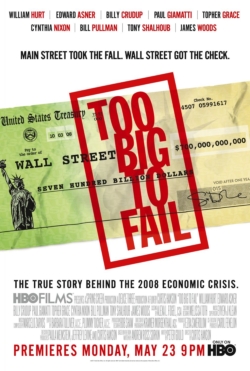
Too big to fail


Resultado de imagen de too big to fail

Title: Too big to fail
Duration: 99 minutes.
Country: United States.
Director: Curtis Hanson
Script: Peter Gould
Year: 2011
Synopsis: Based on the bestselling book by Andrew Ross Sorkin, 'Too Big To Fail' offers an intimate look at the epochal financial crisis of 2008 and the powerful men and women who decided the fate of the world’s economy in a matter of a few weeks. Centering on Treasury Secretary Henry Paulson, the film goes behind closed doors to examine the symbiotic relationship between Wall Street and Washington. William Hurt stars as Paulson; the film also stars (in alphabetical order) Edward Asner, Billy Crudup, Paul Giamatti, Topher Grace, Matthew Modine, Cynthia Nixon, Michael O’Keefe, Bill Pullman, Tony Shalhoub, and James Woods. It co-stars Ayad Akhtar, Kathy Baker, Amy Carlson, Evan Handler, John Heard, Dan Hedaya, Peter Hermann, Chance Kelly, Tom Mason, Ajay Mehta, Laila Robins, Victor Slezak and Joey Slotnick. HBO Films presents a Curtis Hanson Film, in association with Spring Creek Productions; Curtis Hanson directs from a script by Peter Gould; based on the book by Andrew Ross Sorkin; Curtis Hanson, Paula Weinstein and Jeffrey Levine executive produce; Carol Fenelon co-executive produces; Ezra Swerdlow produces; Joe Nocera and Bethany McLean serve as consultants.


'Banking and Finance' in the film
We can find tons of usefull information in this film. The movie as a whole teaches the origin of the financial crisis and how individual interests and the arrogance of many financial actors, bank directors and insurance companies send themselves into bankrupt. In my view, one of the best scenes of the film could be the next one:

Personal comentary
I have found this film quite interesting, because it analyzes the financial crisis not just at science level, but it also studies the leader`s feelings and how they work in their own fall.